Meet the speakers....


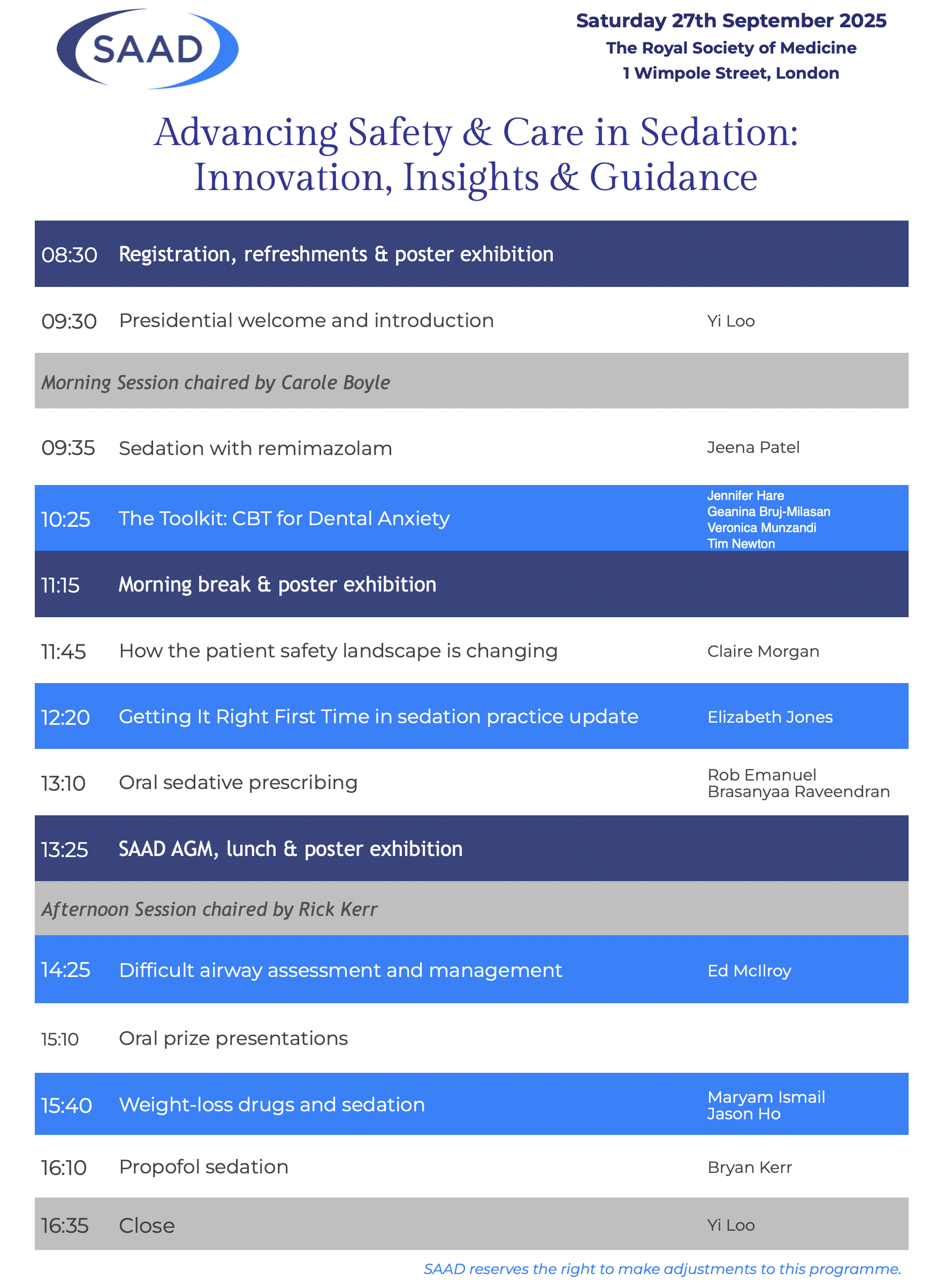
Sedation with Remimazolam 


The Toolkit - CBT for Dental Anxiety


How the patient safety landscape is changing


Getting It Right First Time in sedation practice update


Oral sedative prescribing


Difficult airway assessment and management


SAAD Oral Presentation Prize Presentations


A service evaluation of Kent Community Health's 'A Guide to Inhalation Sedation' animation video

Amy Amanfu

 
Sedation Under Scrutiny – A Systems-Based Approach to Reducing Failure and Variation in Conscious Sedation

Vishnu Sri Shanmuganathan


Weight-loss drugs and sedation


Propofol sedation

Conscious Sedation Complications & Emergency Practice Scenarios

A resource for SAAD members


The IACSD standards document that ‘there must be evidence of regular scenario-based team training in the management of potential complications associated with conscious sedation’.

To facilitate this, SAAD has put together some scenarios and prompts covering sedation related complications, that can be adapted for use by individual sedation teams.

Members of SAAD are free to use these resources. You need to ensure that you keep contemporaneous evidence of these practise sessions.

If you choose to use these scenarios or adaptations of them in a public forum please acknowledge SAAD. SAAD does not support academic plagiarism.

To access the training scenarios, please log on to the website, and then click on the button below. 

SAAD Safe Sedation Practice Scheme

Sedation Complications: Practical Team Training


Event Password:
Your First Name:
Your Last Name:
Your GDC/GMC Number:


Thank you for your feedback.


DSTG and SAAD Position Statement


Summary:

  • DSTG and SAAD are keen to reduce the carbon footprint of nitrous oxide and provide guidance on environmentally sustainable practice in sedation in the UK.
  • DSTG and SAAD support identifying and targeting reduction of structural waste/leaks, clinical waste, and inappropriate use of nitrous oxide.
  • DSTG and SAAD do not support the withholding of access to services for patients benefiting from nitrous oxide sedation for climate impact reasons alone.
  • The decision to use Methoxyflurane, as an alternative to nitrous oxide, should NOT be made on grounds of climate impact alone.

Background:

The NHS has committed to achieving net-zero direct emissions by 2040, this specifically includes anaesthetic gases. Nitrous oxide confers the largest carbon footprint of the anaesthetic gases within the acute sector, accounting for at least 80% of the total anaesthetic gas footprint in 2019/20. Nitrous oxide is a more potent greenhouse gas than carbon dioxide and remains in the atmosphere for 110 years, during which it continues to have a warming effect. Reducing use of nitrous oxide has been reported to result in the most significant reduction in climate impact in sedation/anaesthesia.1

In Dentistry, Inhalation sedation with nitrous oxide and oxygen (IS) is an effective technique with high safety margins and relatively low cost, improving access to dental treatment for thousands of anxious children and adults in the UK each year. This is widely acknowledged to reduce the need for general anaesthesia or more invasive techniques.2 IS is particularly helpful in patients with significant co-morbidities whereby intravenous agents carry a narrower safety margin such as obesity, older frail adults, or cardiac disorders. IS is the recommended technique for conscious sedation in dentistry for children under 12 years old.2 There are no current alternatives to nitrous oxide that have the same evidence base for effectiveness or safety.

Several local and national projects such as The Nitrous Oxide Project have focussed on mitigating nitrous oxide emissions by minimising system waste. Recent reported audits have revealed that leaks and wastage from piped hospital manifold systems is a far more significant problem than that of persistent clinical usage.3 Nitrous oxide use for general anaesthesia has significantly reduced as alternative techniques and drugs have become available, with some anaesthetists reporting that it is no longer needed. This has led to reports of some acute trusts removing nitrous oxide from the manifold, ceasing its availability to clinicians. With the waiting times for paediatric dental interventions escalating nationally, this would further reduce access to care.  Alternatives, such as the provision of care under general anaesthesia itself carries multiple environmental implications when factoring in staffing, single use instruments, PPE, energy, travel and waste.

Inhaled Methoxyflurane (Penthrox) has been proposed as an alternative as it is not as potent a greenhouse gas. Although Methoxyflurane has promise as potentially beneficial to certain groups, it’s use in dentistry is still at an experimental level and more research is needed into safety and delivery.  DSTG and SAAD do not recommend this as a standard technique to replace nitrous oxide.

There are new technologies that are already available that can catalyse waste nitrous oxide and reduce it to non-greenhouse gases. These are promising solutions which warrant further investigation and testing for their overall impact and costs before they are widely available.

Conclusion:

DSTG and SAAD recommend the continued appropriate use of nitrous oxide and oxygen for inhalation sedation for children and adults. Clinicians should identify ways to reduce waste gases as much as practicable. Further work is encouraged on alternative drugs / techniques and new technologies to reduce the climate impact of nitrous oxide.   

References:

  1. RCA https://rcoa.ac.uk/patient-information/about-anaesthesia-perioperative-care/your-anaesthetic-environment
  2. IACSD Standards for Conscious Sedation in the Provision of Dental Care (V1.1)
  3. AoA https://anaesthetists.org/Home/Resources-publications/Environment/Nitrous-oxide-project

Updated 16.11.2021